Our Islamic Studies core syllabus is taken from the Safar Islamic Studies Series of books, which is widely used in Islamic education settings. Every textbook in the series introduces age-appropriate units from these five core areas:
- ʿAqīdah: Core tenets of faith, such as Islamic monotheism (Tawheed), the Articles of Faith, the attributes of Allāh, and understanding Paradise (Jannah) and Hell (Jahannam).
- Fiqh: Operational and practical acts of worship, including the Five Pillars of Islam, cleanliness rules (Wudu), performance of the daily prayers (Salah), fasting (Sawm), charity (Zakah), and the pilgrimage (Hajj).
- Islamic History & Sīrah: Narrative-driven timelines covering the stories of the major Quranic Prophets (such as Prophets Ādam, Nūḥ, Ibrāhīm, Mūsā, and ʿĪsā) and the chronological, detailed life of the Prophet Muḥammad ﷺ.
- Personal Development (Ādāb & Akhlāq): Practical life skills, moral development, Islamic manners, classroom behavior, everyday reminders, and basic daily supplications (Du’as).
Primary Syllabus (Books 1–6)
Designed for ages 5 to 11, typically taught at a pace of one book per academic year
| Level / Book | Target Age & Stage | Key Topics & Focus Elements |
| Book 1 & 2 | Ages 5–7 (UK Year 1–2) | Foundational Essentials: Concepts of identity (“Who am I?”), intro to Allāh and the four major angels, fundamental cleanliness and toilet etiquette, basic names/times of the five daily prayers, Arabic alphabet, saying Salām, and introductory stories of Prophets Ādam and Nūḥ. |
| Book 3 & 4 | Ages 7–9 (UK Year 3–4) | Expanding Worship & Belief: The Six Articles of Faith, structured implementation of Wudu and how to pray Salah step-by-step, the Islamic calendar months, expanding on charity (Sadaqah) and fasting rules, and the prophetic journeys of Prophets Ibrāhīm, Yunus, and Mūsā. |
| Book 5 & 6 | Ages 9–11 (UK Year 5–6) | Consolidation & Rites: Advanced breakdown of the conditions of faith (Predestination, Judgement Day), full components of Hajj, executing duties in an informed manner, and deep-dive timelines into the late Makkan and Madinan phases of the Sīrah of Prophet Muḥammad ﷺ. |
Secondary Syllabus (Books 7–8)
Designed for ages 11 to 17, with each comprehensive volume intended to be taught across two academic years due to the depth of contemporary discussion:
| Level / Book | Target Age & Stage | Key Topics & Focus Elements |
| Book 7 | Ages 11–13+ (UK Year 7–8) | Islam and the Social World: Over 25 specialized topics dealing with spiritual development, the Muslim scholarly tradition, societal obligations, citizenship, and applying Islamic values within modern globalized contexts. |
| Book 8 | Ages 13–17 (UK Year 9–) | Contemporary Realities & Identity: Advanced theology, critical analysis of lifestyle choices, spiritual self-rectification (Tazkiyah), life skills, and navigating complex modern social issues. Includes a comprehensive “Essential Knowledge” refresher unit for beginners or adult learners. |
Arabic & Qur’anic Studies
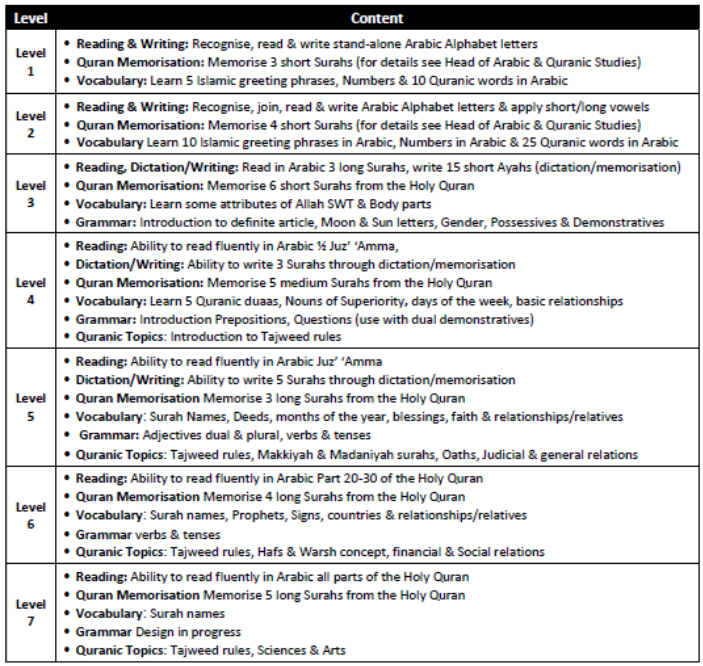
MKIS introduced a new syllabus for Arabic Qur’anic Studies in 2027 which was developed in-house and based on parents’ feedback; the new syllabus provides:
- Emphasis on Qur’an Reading & Memorisation (including Arabic letters pronunciation & joining)
- Less grammar but a variety of Qur’anic vocabulary & Qur’anic studies
- Progressive learning designed into 4 areas (reading, writing, vocabulary & memorisation)
All students (irrespective of age) are required to sit a short assessment to gauge their existing Arabic knowledge before being assigned to a suitable level.